Automatic Gates are powered gate systems designed to open and close without requiring someone to move the gate manually. An automatic gate normally combines a physical gate with an operator, control equipment, access devices, and safety components.
Depending on the design, an automatic gate may slide horizontally, swing on hinges, fold, or use a barrier arm to control vehicle access. These systems are used in residential, commercial, industrial, and parking environments where controlled entry and convenient vehicle access are required.
However, automation is not only about convenience. A powered gate can create crushing, trapping, or impact hazards if it is poorly designed, installed, or maintained. Safety therefore needs to be considered as part of the complete gate system.
What Are Automatic Gates?
An automatic gate is a gate operated by a powered mechanism rather than entirely by hand. The operator receives a command from a control device and moves the gate through its opening or closing cycle.
Common control methods include remote controls, keypads, card readers, and other access-control devices. The exact equipment depends on the gate design and the requirements of the property.
Automatic Gates can be installed at private driveways, residential communities, commercial properties, industrial entrances, parking facilities, and other locations where vehicle movement needs to be controlled.
How Do Automatic Gates Work?
The basic operation begins when an authorized user sends an opening command. For example, the command may come from a remote control or an access-control device. The control system activates the gate operator, which supplies the mechanical force needed to move the gate. A sliding gate moves along Automatic Gates travel path, while a swing gate rotates around its hinges. A barrier gate raises or lowers its arm.
Safety equipment can also be incorporated into the system. Depending on the installation, sensors, safety edges, force limitation, and other protective measures can help detect hazards or reduce the risk created by a moving gate.
What Are the Main Components of an Automatic Gate?
Although systems differ, many Automatic Gates include several basic components:
- Gate: The physical barrier that controls the entrance.
- Gate operator: The powered mechanism that moves the gate.
- Control system: Electronics that manage commands and gate movement.
- Access device: A remote control, keypad, card reader, or another authorized control.
- Safety equipment: Devices such as photoelectric sensors or safety edges may be used for entrapment protection.
- Manual-release mechanism: Some systems provide a way to disengage the operator during a power failure or emergency.
- Vehicle detection: Some installations use vehicle-detection equipment as part of the access or safety system.
The exact combination depends on the gate type, operator, site conditions, and applicable safety requirements.
Where Are Automatic Gates Commonly Used?
Automatic Gates are commonly used where controlled vehicle access is required. Typical locations include private homes, apartment and residential communities, commercial properties, industrial facilities, parking areas, and other controlled entrances.
The appropriate gate design depends on factors such as available space, traffic volume, gate size, operating frequency, and the level of access control required.
What Are the Different Types of Automatic Gates?
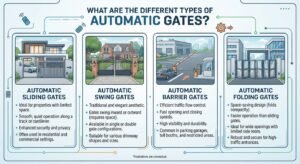
Automatic Gates are available in different designs, and the main difference is how the gate moves. Sliding gates move sideways, swing gates rotate around hinges, folding gates fold into sections, and barrier gates use a movable arm to control vehicle passage.
Automatic Sliding Gates
Automatic sliding gates move horizontally rather than swinging across the driveway. Many sliding gates use rollers and a ground track, while cantilever designs can use support rollers without a conventional ground track. Sliding gates can be useful when there is insufficient space for a swing gate’s opening arc but adequate space is available alongside the entrance.
A tracked sliding gate also requires attention to the condition of Automatic Gates track and rollers. Dirt or debris can interfere with movement and increase mechanical resistance.
Automatic Swing Gates
Automatic swing gates open and close by rotating around hinges. They may use one gate leaf or two leaves, depending on the entrance design. Operators can use different mechanisms, including linear actuators or articulated arms. The operator must be appropriate for the gate’s size, weight, hinge condition, and operating requirements.
Automatic Barrier Gates
Automatic barrier gates use a movable arm to regulate vehicle entry and exit. Unlike a full-height driveway gate, a barrier arm primarily controls vehicle passage rather than creating a solid physical perimeter barrier. They are commonly associated with parking facilities and other locations where vehicles need to pass through a controlled point.
Automatic Folding Gates
Automatic folding gates use connected sections that fold as the gate opens. Their folding movement can be useful where the available space does not suit a conventional swinging gate. Different folding designs use different mechanical arrangements and automation systems.
Because folding gates contain multiple moving sections and joints, the installation should account for potential pinch and entrapment areas and provide appropriate safety protection.
What Are the Benefits of Automatic Gates?
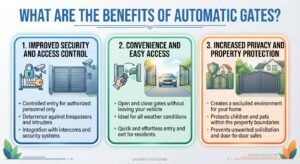
The main reasons people choose Automatic Gates are controlled access and convenience. A properly designed system can make routine vehicle entry easier while allowing property owners or operators to manage who can enter. The actual benefits depend on the gate design and access-control equipment.
Improved Security and Access Control
Automatic Gates can help control vehicle access when they are combined with appropriate access-control equipment.
Convenience and Easy Access
Convenience is one of the most obvious benefits of Automatic Gates. A user can operate the gate through a compatible control device instead of manually opening and closing it. This can be particularly useful at frequently used vehicle entrances.
Convenience also depends on reliable installation and maintenance. Mechanical problems, damaged components, or faulty safety equipment can interfere with normal operation.
Increased Privacy and Property Protection
A physical gate can help define the entrance to a property and restrict uncontrolled vehicle access. When combined with suitable fencing or walls, a gate can also create a clearer physical boundary around a property. The amount of privacy provided depends on the gate’s construction and whether it has open or solid sections.
What Features Do Automatic Gates Have?
Automatic Gates can be relatively simple or can form part of a larger electronic access-control system. Available features vary according to the manufacturer, operator, gate type, and application.
Remote Controls and Keypads
Remote controls allow authorized users to send an operating command to the gate without manually moving Automatic Gates. Keypads provide another method by requiring a user to enter an access code. Other installations may use card readers, scanners, or similar access-control equipment.
Safety Sensors and Obstacle Detection
Safety equipment is an important part of an Automatic Gates installation because powered gates can create entrapment and impact hazards. Depending on the system, safety protection can include photoelectric beams, sensing edges, force limitation, and other protective arrangements.
The correct safety configuration depends on the specific gate and operator. Safety guidance from the U.K. Health and Safety Executive emphasizes that powered-gate safety depends on the combination of the gate, controls, sensors, safety devices, installation, and ongoing maintenance rather than on one component alone.
Smart Access and Security Systems
Some Automatic Gates can be integrated with electronic access-control systems. Depending on the equipment, users may be able to manage access through different credentials or communication systems. More advanced installations can connect the gate to broader property-access systems.
Smart access should not replace physical safety equipment. Access control determines who can operate or enter through a gate, while safety equipment addresses hazards created by the gate’s movement.
How Much Do Automatic Gates Cost?

The cost of Automatic Gates varies considerably because every installation is different. Gate size, material, design, operator type, site preparation, electrical work, safety equipment, access-control equipment, and labor can all affect the final price.
For a current U.S. reference point, Angi’s 2026 data reports an average automatic-gate installation cost of about $4,000, with a typical range of approximately $2,380 to $8,000. These figures are U.S. estimates and should not be treated as universal prices for every country.
Factors That Affect Automatic Gate Prices
Several factors can influence the cost of Automatic Gates:
- Gate dimensions
- Gate material and construction
- Sliding, swing, folding, or barrier design
- Operator type and capacity
- Site preparation
- Electrical requirements
- Safety equipment
- Access-control equipment
- Installation complexity
- Local labor and permit costs
Installation and Setup Costs
Installing an automatic gate involves more than mounting a motor. The installer may need to prepare the gate, install the operator, connect electrical equipment, install control devices and safety equipment, adjust the system, and test its operation.
Site preparation can become a significant part of the project when electrical upgrades, structural work, difficult ground conditions, or other modifications are necessary. Angi also identifies site preparation, electrical upgrades, gate size, and terrain as factors affecting installation costs.
Maintenance and Repair Costs
Automatic Gates contain mechanical and electrical components that can wear over time. Maintenance may involve checking the gate’s movement, inspecting mechanical parts, checking safety equipment, and addressing problems before they become more serious.
Repair costs depend on what has failed. A simple adjustment can be very different from replacing an operator, control board, motor, or structural component. The best maintenance schedule is the one specified by the equipment manufacturer and adjusted where necessary for the gate’s operating environment and usage.
How Are Automatic Gates Installed and Maintained?
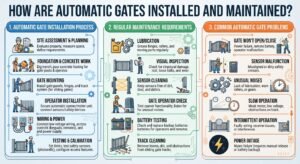
Installing Automatic Gates should involve the complete system rather than treating the motor as a separate product. The gate structure, operator, controls, safety devices, electrical supply, and surrounding environment all affect how safely the finished system operates.
Automatic Gate Installation Process
Installation normally begins with an assessment of the entrance. The installer needs to consider the gate’s dimensions, weight, movement, available space, ground conditions, frequency of use, and surrounding hazards. The appropriate operator and safety equipment can then be selected.
After installation, the system should be adjusted and tested to verify that the gate operates correctly and that the safety measures function as intended. The HSE emphasizes that powered gates should be properly designed, installed by competent contractors, regularly checked, and maintained.
Regular Maintenance Requirements
Regular maintenance helps identify mechanical and safety problems before they become more serious. Owners should pay attention to unusual sounds, changes in movement, damaged components, alignment problems, and safety devices that do not operate correctly.
Sliding gates may require particular attention to tracks and rollers where those components are used. Other gate designs have different mechanical requirements. Maintenance should follow the manufacturer’s instructions, because there is no single maintenance procedure that applies to every automatic gate.
Common Automatic Gate Problems
Automatic Gates can develop different problems depending on their design and operating environment. Common examples include:
- Slow or uneven movement
- Mechanical resistance
- Track or roller problems on tracked sliding gates
- Misalignment
- Faulty remote controls
- Access-control problems
- Damaged or incorrectly positioned safety sensors
- Electrical or control-system faults
- Operator or motor problems
A gate that moves unexpectedly or has a malfunctioning safety device should not simply be operated repeatedly. The problem should be investigated and repaired appropriately.
Are Automatic Gates Safe?
Automatic Gates can be operated safely when they are properly designed, installed, protected, and maintained. However, powered gates can create serious hazards. The HSE identifies risks associated with crushing, trapping, moving components, gaps, and other hazards around powered gates. It also emphasizes that safety depends on the complete system and its ongoing maintenance.
Important Automatic Gate Safety Features
Depending on the installation, safety features may include:
- Photoelectric safety beams
- Pressure-sensitive safety edges
- Force limitation
- Appropriate control systems
- Emergency or manual-release arrangements
- Guards around hazardous areas
- Properly designed gate travel paths
No single safety device should automatically be assumed to make every gate safe. The protection required depends on the gate’s design, movement, environment, and foreseeable use.
How to Prevent Gate-Related Accidents
People should stay clear of moving gates and avoid standing in areas where they could become trapped or struck. Safety devices should never be deliberately bypassed or disabled. Regular inspection is also important because sensors, mechanical parts, and other components can wear or fail.
The HSE has documented serious incidents involving powered gates where people became trapped because hazards were not properly detected and closing forces were too high. Its guidance recommends appropriate safety measures and regular testing and maintenance.
What to Do During a Power Outage
The response to a power outage depends on the specific Automatic Gates system. Some operators provide a manual-release mechanism, while some installations may include backup power. The correct procedure should always follow the manufacturer’s instructions.
Property owners should know how the gate can be released or opened safely if normal electrical operation is unavailable. HSE guidance also emphasizes that powered gates should have an appropriate method of dealing with power failure.
Read more : Campbell: What It Is and Why It Matters
How to Choose the Right Automatic Gate?
Choosing Automatic Gates starts with the property rather than the motor. Consider the entrance layout, gate movement, available space, traffic level, expected operating frequency, security requirements, safety needs, and maintenance requirements.
Consider Your Property and Available Space
Available space can determine which gate design is practical. A swing gate needs sufficient space for its opening arc. A sliding gate needs space beside the entrance for the gate to travel. Folding gates have their own movement requirements, while barrier gates are designed primarily to control vehicle passage. The driveway slope, ground condition, surrounding structures, and location of pedestrians should also be considered during the planning stage.
Choose the Right Gate Type and Motor
The operator should be matched to the gate. Important factors include the gate’s size, weight, movement type, operating frequency, and mechanical condition. A gate operator that is unsuitable for the particular gate can result in unreliable operation or excessive mechanical stress.
Consider Security, Durability, and Maintenance
Think about how the gate will actually be used. A private driveway with occasional use may have different requirements from a commercial entrance with frequent vehicle movement. Access-control requirements can also vary significantly between properties. Consider not only the purchase price but also installation, safety equipment, maintenance, repairs, electrical requirements, and the availability of replacement parts or professional service.
Final Thoughts
Automatic Gates can make vehicle access more convenient while providing a way to control entry to residential, commercial, industrial, and other properties. The right system depends on more than choosing a motor. Gate type, available space, gate size and weight, operating frequency, access control, safety equipment, installation conditions, and maintenance all need to be considered together.
Most importantly, automation should never come at the expense of safety. A properly designed and maintained gate should account for people who may interact with it, possible obstructions, power failures, mechanical wear, and the conditions in which the gate operates.
FAQs About Automatic Gates
Are Automatic Gates Worth Installing?
Automatic Gates can provide convenient, controlled vehicle access for homes and businesses. Their suitability depends on the property layout, security needs, budget, usage, and maintenance requirements.
How Long Do Automatic Gates Last?
There is no fixed lifespan for every automatic gate because durability depends on construction, usage, installation, environment, and maintenance. Individual components may need repair or replacement before the complete system.
Can Automatic Gates Work During a Power Outage?
Some Automatic Gates can operate with backup power, while others include a manual-release mechanism for power failures. The correct method depends on the specific operator and manufacturer’s instructions.
How Often Should Automatic Gates Be Maintained?
Maintenance frequency varies according to the manufacturer, gate usage, and operating environment. Regular inspections and maintenance can help identify worn components, damaged safety equipment, and other problems.
Can an Existing Gate Be Converted to Automatic?
Many existing gates can potentially be automated if their structure and movement are suitable for an operator. The conversion may require an appropriate motor, safety devices, controls, and electrical work.