Being independent can be a positive quality. It can help people make decisions, solve problems, manage responsibilities, and develop confidence in their abilities. However, self-reliance can become difficult when a person feels that they must handle almost everything alone and finds it extremely uncomfortable to accept appropriate support.
This pattern is often called hyper independence. The term is commonly used in psychology and self-development discussions to describe excessive or rigid self-reliance. However, it is important to understand that it is not a formal mental health diagnosis.
Instead, the behaviors associated with hyper independence can overlap with established psychological concepts, including attachment patterns, help-seeking behavior, emotional avoidance, and social connection. Understanding this distinction helps keep the topic accurate rather than treating an informal label as a medical condition.
What Is Hyper Independence?
Hyper independence generally describes a strong preference or perceived need to rely on yourself rather than depend on other people.
Someone who identifies with this pattern may have difficulty asking for help, accepting support, sharing personal struggles, or allowing another person to take responsibility for part of a problem.
Being independent does not automatically mean there is a problem. Many people are comfortable solving problems themselves while also accepting help when necessary. The concern arises when self-reliance becomes so rigid that it creates stress or interferes with relationships and everyday life.
Definition of Hyper Independence
There is no single official clinical definition of hyper independence because it is not a recognized mental health disorder.
In everyday use, the phrase usually refers to extreme or inflexible self-reliance. A person may believe they should solve problems alone, avoid asking for assistance, or feel uncomfortable when someone tries to help.
Hyper Independence vs. Healthy Independence
Healthy independence means being capable of making decisions and taking responsibility for your life while still being able to cooperate with others.
For example, an independent person might try to solve a problem themselves but ask a trusted person for assistance when the situation becomes difficult.
How Hyper Independence Can Develop
There is no single explanation for why someone becomes extremely self-reliant. A person’s experiences, relationships, expectations, coping strategies, and social environment can all influence how comfortable they are with depending on others.
Research into attachment has found associations between early relationship experiences and later attachment patterns. However, this does not mean that every person who displays strong self-reliance experienced childhood trauma or neglect.
It is more accurate to view hyper independence as a possible pattern that can develop for different reasons rather than as the inevitable result of one particular experience.
What Causes Hyper Independence?
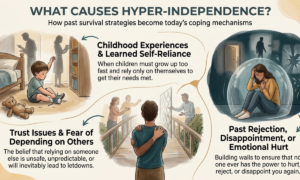
Hyper independence does not have one proven cause. Different people may develop strong self-reliance for different reasons.
Some may have learned early that they needed to solve problems themselves. Others may have become cautious about depending on people after difficult relationships or repeated disappointment.
These possibilities should be considered carefully rather than treated as universal explanations.
Childhood Experiences and Learned Self-Reliance
Early relationships can influence how people learn to understand trust, support, and emotional needs.
When a person repeatedly experiences inconsistent or unavailable support, becoming more self-reliant may become an understandable coping strategy. Research on attachment has examined connections between early relationship experiences and later attachment patterns.
However, childhood experience is only one possible factor. It would be inaccurate to say that hyper independence always comes from childhood trauma.
Trust Issues and Fear of Depending on Others
Trust can influence how comfortable someone feels accepting help. A person who expects others to be unreliable may prefer to remain responsible for everything themselves. Depending on another person can feel uncertain because it requires giving up some control and allowing another person to become involved.
Research on attachment avoidance has examined patterns involving discomfort with closeness, dependence, and emotional support. These findings can help explain some behaviors that people informally describe as hyper independence.
Past Rejection, Disappointment, or Emotional Hurt
Difficult experiences can influence how people approach future relationships. Someone who has repeatedly experienced disappointment may become more cautious about depending on others. Avoiding reliance can then feel safer or more predictable.
However, there is no single experience that explains hyper independence in every person. Personal history matters, and the same experience can affect different people in different ways.
What Are the Signs of Hyper Independence?
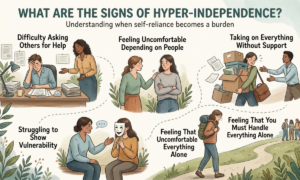
The signs associated with hyper independence are usually related to an unusually strong or inflexible preference for self-reliance.
One sign alone does not establish that someone is hyper independent. The broader pattern and its impact on relationships and daily life are more important.
Difficulty Asking Others for Help
A common pattern is avoiding help even when assistance would be reasonable. Someone may continue struggling with a task rather than asking a friend, partner, family member, or coworker for assistance.
The difficulty may be practical, emotional, or both. The person may believe that asking for help creates weakness, inconvenience, dependence, or an obligation to the other person.
Feeling Uncomfortable Depending on People
Depending on someone else can require trust. A person with strong self-reliant tendencies may feel uncomfortable allowing another person to take responsibility for something important. They may prefer to remain in control because handling the situation themselves feels more predictable.
Taking on Everything Without Support
Another possible sign is repeatedly taking responsibility for tasks that could reasonably be shared. This can happen at home, in friendships, at work, or in romantic relationships.
Taking responsibility is not inherently unhealthy. The concern is when someone consistently takes on too much because they feel unable or unwilling to let trustworthy people contribute.
Struggling to Show Vulnerability
Vulnerability involves allowing another person to see your emotions, uncertainty, needs, or difficulties. Someone who strongly values self-reliance may find this uncomfortable and keep personal struggles private.
This can make relationships more difficult when other people want to provide emotional support but do not know what the person is experiencing.
Feeling That You Must Handle Everything Alone
Perhaps the clearest pattern is the belief that you have to manage problems by yourself regardless of the circumstances. There is an important difference between saying, “I can handle this,” and feeling, “I have no choice but to handle this alone.”
How Hyper Independence Affects Relationships
Relationships involve more than companionship. They can also provide emotional and practical support. The CDC notes that supportive social connections can provide emotional and practical assistance and are important to mental and physical well-being.
When someone has difficulty accepting support, maintaining close relationships may become more complicated.
Difficulty Building Emotional Trust
Emotional trust develops over time through reliable interactions and communication. If a person rarely shares their needs or allows others to help, the other person may have fewer opportunities to demonstrate that they are trustworthy.
This does not mean that hyper independence automatically prevents close relationships. It means that rigid self-reliance can make emotional closeness more difficult for some people.
Problems With Communication and Support
Healthy relationships usually require people to communicate their needs and expectations. If someone consistently says they are fine when they are actually struggling, their partner or friend may not know how to respond.
The result can be misunderstanding rather than a lack of care. Clear communication can make support more useful. A person can explain whether they want advice, practical assistance, emotional reassurance, or simply someone to listen.
Balancing Independence and Connection
Independence and connection do not have to be opposites. A person can maintain personal goals, opinions, boundaries, and responsibilities while also accepting support from trusted people.
The CDC emphasizes that meaningful social connections can provide support and contribute to health and well-being. The goal is therefore not to eliminate independence but to make hyper independence flexible.
How Hyper Independence Affects Daily Life

Strong self-reliance can affect everyday responsibilities as well as relationships. When someone consistently refuses assistance, they may end up managing more tasks than necessary.
Stress From Taking on Too Much
Taking on excessive responsibility can increase pressure, particularly when there is little opportunity for rest or support.
The WHO identifies factors such as high workload, time pressure, long working hours, and lack of support as psychosocial risks associated with occupational stress and burnout.
This does not mean hyper independence directly causes burnout. Rather, consistently carrying excessive responsibilities without adequate support can contribute to stressful circumstances.
Difficulty Accepting Help at Work or Home
Some people may reject assistance because they believe they can complete the task better or faster themselves. Sometimes that may be true. But consistently refusing reasonable assistance can make shared responsibilities unnecessarily difficult.
At work, this might involve difficulty delegating appropriate tasks. At home, hyper independence could mean refusing help with everyday responsibilities even when support is available.
Emotional Exhaustion and Burnout
Continually managing high demands without enough support or recovery can contribute to stress.
hyper independence is important, however, to use the term burnout accurately. WHO defines burnout specifically as an occupational phenomenon resulting from chronic workplace stress that has not been successfully managed.
Therefore, an article about hyper independence should not describe every form of emotional exhaustion as burnout.
How to Overcome Hyper Independence
Overcoming hyper independence does not mean becoming dependent on everyone. A healthier goal is to develop a wider range of choices. You can remain capable and independent while becoming more comfortable accepting appropriate support.
Start by Accepting Small Offers of Help
Small changes can be easier than trying to change your entire behavior immediately. If a trustworthy person offers reasonable assistance, consider accepting hyper independence instead of automatically refusing.
The CDC recommends reaching out to others and building meaningful social connections through small, consistent actions. Accepting help with a small task can also show you that receiving support does not necessarily mean losing independence.
Practice Asking for Support
Asking for help is a skill that can become easier with practice. Start with something specific. Instead of saying, “I need help with everything,” identify one practical or emotional need.
Learn to Trust Others Gradually
Trust does not have to be immediate or absolute. Begin with people who have shown consistent reliability and respect. Allow trust to develop through repeated experiences rather than assuming that you must either depend completely on someone or never depend on them at all. This approach allows you to maintain reasonable boundaries while becoming more comfortable with cooperation.
Become More Comfortable With Vulnerability
You do not need to share every private thought with everyone. Instead, practice appropriate vulnerability with people you trust.
You might tell a close friend that you are having a difficult day or tell a partner that you need emotional support. The purpose is not to remove your privacy or boundaries. hyper independence is to become more comfortable communicating genuine needs.
Set Healthy Boundaries
Becoming less hyper independent does not mean accepting every request or allowing everyone into your personal life. Healthy boundaries remain important.
You can decide who you trust, what information you share, what help you accept, and what responsibilities remain yours.
How to Build Healthy Interdependence
Healthy interdependence means people can maintain their individuality while also giving and receiving appropriate support. Hyper independence does not require someone to lose their independence.
Understanding Give-and-Take in Relationships
Support should generally work in both directions. The CDC describes meaningful social connections as relationships in which people can experience care, belonging, and support.
If you are accustomed to doing everything alone, receiving help may initially feel uncomfortable. Remember that accepting reasonable support can also strengthen a relationship by allowing another person to participate and contribute.
Communicating Your Needs Clearly
Other people cannot always know what you need. Clear communication can make relationships easier to navigate.
Instead of expecting someone to recognize that you are struggling, explain what would actually help. For example, you can say that you want someone to listen rather than give advice, or that you need practical assistance with a particular task.
Staying Independent While Accepting Support
Healthy interdependence does not mean giving up control of your life. You can make your own decisions, maintain your own interests, manage your responsibilities, and still accept support when appropriate. Independence becomes healthier when it is a choice rather than an unbreakable rule.
Read more : Is Quikconsole com Worth Using? Honest Review
When to Seek Professional Support
Hyper independence itself is not a formal diagnosis. If strong self-reliance is causing significant distress or making relationships and daily responsibilities difficult, a qualified mental-health professional can help explore the underlying issues.
Professional support can be particularly useful when difficulties with self-reliance occur alongside persistent anxiety, depression, trauma-related symptoms, severe stress, or other mental-health concerns.
Signs That Extra Support May Be Helpful
Consider seeking professional guidance if you:
- Feel unable to ask anyone for help even during serious difficulties.
- Experience persistent distress because of relationship or trust problems.
- Consistently isolate yourself from supportive people.
- Struggle to manage responsibilities because you refuse reasonable assistance.
- Experience ongoing anxiety, low mood, or other concerning symptoms.
- Find that these patterns are interfering with work, relationships, or everyday functioning.
These signs do not prove that someone has a particular disorder. They simply indicate that additional support may be useful.
How Professional Guidance Can Support Change
A mental-health professional can help you examine your thoughts, emotions, relationships, and coping patterns without assuming that one label explains everything. Depending on the person’s needs, therapy may focus on communication, emotional regulation, relationships, coping strategies, or other concerns contributing to distress.
The CDC also identifies psychological therapies among approaches that can help improve social connection for some people.
Final Thoughts
Hyper independence is a useful term for discussing extreme or rigid self-reliance, but it should not be treated as a formal mental-health diagnosis. Being capable, responsible, and independent can be valuable. The challenge begins when a person feels that they must handle everything alone, even when trustworthy support is available.
A healthier approach is to keep the strengths of independence while becoming more flexible about receiving help. You can maintain your boundaries, make your own decisions, and remain responsible for your life while still allowing trusted people to support you.
FAQs About Hyper Independence
Is It a Mental Health Disorder?
No. Hyper independence is an informal term, not a formal mental-health diagnosis.
It can describe behaviors that overlap with concepts such as attachment patterns, emotional avoidance, and self-reliance.
What Are the Most Common Signs of Hyper Independence?
Common signs can include difficulty asking for help, discomfort depending on others, excessive self-reliance, and avoiding emotional vulnerability. Having one or more of these behaviors does not automatically mean someone is hyper independent.
Why Is It So Hard for Hyper Independent People to Ask for Help?
For some people, asking for help may feel uncomfortable because it involves dependence, vulnerability, uncertainty, or reduced control. The reason varies from person to person, so there is no single explanation for strong self-reliance.
Can Hyper Independence Affect Romantic Relationships?
Hyper independence can make relationships more difficult when extreme self-reliance limits communication, emotional closeness, or the ability to accept support. Healthy independence, however, can coexist with trust, connection, and mutual support.
How Can I Become Less Hyper Independent?
Start gradually by accepting appropriate help, making small requests, communicating your needs, and building trust with reliable people. If self-reliance causes significant distress or affects daily life, professional support may be helpful.